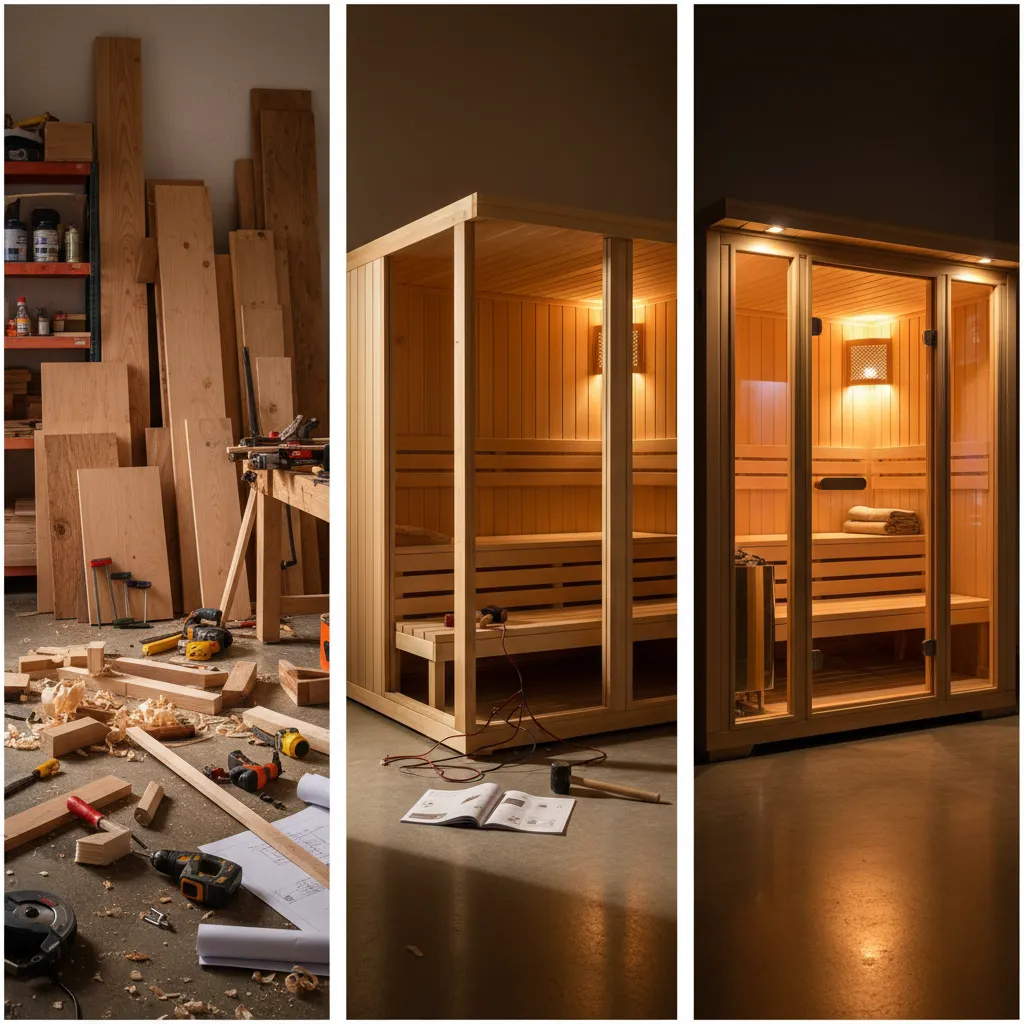
DIY Sauna vs Kit vs Pre-Built: Costs, Timelines, What to Expect
Should you build a sauna from scratch, buy a kit, or go pre-built? Real costs, labor hours, skill requirements, and the hidden expenses for each option.
Quick answer: A DIY sauna build runs $2,000 to $8,000 in materials and 40 to 100+ hours of intermediate carpentry; a kit runs $3,000 to $15,000 and 15 to 40 hours of basic assembly; pre-built units run $2,000 to $30,000 and set up in 1 to 8 hours. Whichever route you pick, the sauna itself is often only 50 to 70 percent of the total, so budget $500 to $2,500 for an electrician plus permits, foundation, and delivery. Kits are the sweet spot for most handy buyers because the vapor barrier, the number one DIY failure point, is already built into the panels.
Best for
Buyers weighing whether to build, assemble, or buy their home sauna and wanting real all-in numbers before committing.
Wrong fit
Anyone not yet sure they will use a sauna regularly; a $200 to $1,200 portable unit is the smarter first step.
Tradeoff
DIY saves the most money but carries the moisture-management risk that ruins builds, while pre-built costs the most and trades away nearly all customization.
Three ways to get a home sauna. Each one trades money for time and skill in different ways.
The internet makes all three sound easy. Reality is more complicated. A true DIY build requires real carpentry. A kit still needs a weekend and an electrician. And "pre-built" does not always mean plug-and-play.
This guide gives you the numbers, real timelines, and the hidden costs nobody mentions until you are already committed.
What you will learn:
True total cost for each option (not just sticker price)
Skill level and tools required
Realistic time to completion
Hidden costs that catch people off guard
A decision framework based on your situation
The Three Options at a Glance
Factor
DIY Build
Sauna Kit
Pre-Built / Modular
Total cost
$2,000 - $8,000
$3,000 - $15,000
$2,000 - $30,000
Skill needed
Intermediate carpentry
Basic handy skills
Minimal
Tools needed
Full workshop
Basic power tools
Screwdriver, maybe
Time to complete
40 - 100+ hours
15 - 40 hours
1 - 8 hours
Customization
Total control
Some flexibility
Very limited
Electrician needed?
Yes
Yes
Depends on type
Permit needed?
Likely
Maybe
Maybe
A few things jump out. The cost ranges overlap significantly. A high-end DIY build can cost more than a basic pre-built. And a premium kit can exceed the price of a mid-range modular unit. The right choice depends on what you value, not just your budget.
Option 1: True DIY (Build From Scratch)
Cost range: $2,000 - $8,000 for materials
Time: 40 - 100+ hours of labor
Skill level: Intermediate to advanced carpentry
This means buying lumber, insulation, vapor barrier, and a heater separately. You design the layout, frame the walls, install the ventilation, build the benches, and wire the heater.
The real advantage: Complete control. You choose the wood type, the bench layout, the heater position, the ceiling height. If you have an odd-shaped space or a specific vision, DIY is the only path that gets you there exactly.
The real risk: Moisture problems. The number one reason DIY saunas fail is improper vapor barrier installation. If moisture gets behind the walls, you get mold and rot that you will not notice until the damage is serious. This is not a forgiving mistake.
Option 2: Sauna Kit (Pre-Cut, You Assemble)
Cost range: $3,000 - $15,000 (typically includes heater)
Time: 15 - 40 hours (1 to 3 weekends)
Skill level: Basic handy skills, ability to follow instructions
A kit arrives with pre-cut wood panels, a heater, hardware, and assembly instructions. You are essentially putting together a large piece of furniture. The framing, insulation, and vapor barrier are already built into the panels.
What a typical kit includes:
Pre-cut and pre-finished wall panels
Bench components (pre-drilled)
Heater with stones
Door
Ventilation components
Hardware and instructions
What a kit does NOT include:
Foundation or floor preparation
Electrical work (you still need a licensed electrician)
The sweet spot: Kits eliminate the two hardest parts of a sauna build: designing the vapor barrier system and cutting wood to precise dimensions. You get the satisfaction of building it yourself without the risk of getting the moisture management wrong.
Watch out for: Cheap kits with thin panels. If the walls are under 2 inches thick, insulation will be minimal. Your sauna will take longer to heat and cost more to run. Quality kits use tongue-and-groove panels that are 2 to 3 inches thick with proper insulation built in.
Option 3: Pre-Built / Modular (Delivered Ready)
Cost range: $2,000 - $30,000
Time: 1 - 8 hours (unpack and set up)
Skill level: Minimal
This category is wide. It includes everything from a $2,000 infrared cabin that plugs into a standard outlet to a $30,000 outdoor barrel sauna delivered on a flatbed truck.
Sub-categories:
Infrared cabins ($2,000 - $8,000): Arrive in panels, assemble in 1-2 hours, plug into a standard 120V outlet. No electrician needed. Not a traditional sauna experience, but the lowest barrier to entry. See our infrared vs traditional comparison.
Indoor modular ($4,000 - $15,000): Pre-assembled panels that click or bolt together. Similar to a kit but with less assembly required. Most need a 240V circuit, so you still need an electrician.
Outdoor barrel or cabin ($6,000 - $25,000+): Delivered assembled or in large sections. Needs a level foundation (concrete pad, gravel bed, or deck). Crane or forklift may be required for delivery. Check our outdoor sauna foundation guide for foundation details.
Custom pre-built ($15,000 - $30,000+): Built off-site to your specifications, delivered and installed. The premium option for people who want a custom sauna without the construction process in their home.
The Hidden Costs Nobody Mentions
This is where budgets break. The sauna itself is often only 50-70% of the total project cost.
Electrical Work ($500 - $2,500)
Almost every traditional sauna needs a dedicated 240V circuit with the right amperage. This means hiring a licensed electrician. If your electrical panel is full, you may need a panel upgrade, which can add $1,000-$2,000 by itself. This applies to DIY, kits, and most pre-built options. Only low-wattage infrared units on 120V circuits skip this cost.
Permits ($100 - $500)
Many jurisdictions require permits for electrical work, and some require permits for any structure over a certain size. Outdoor saunas may need a building permit depending on your local codes. Skipping permits can cause problems when you sell your home.
Foundation / Site Prep ($200 - $2,000)
Outdoor saunas need a level surface that can handle the weight. A simple gravel pad costs $200-$500. A concrete slab costs $1,000-$2,000. Indoor installations may need floor reinforcement or waterproofing.
Delivery ($0 - $1,500)
Kits and modular units are heavy. Freight shipping for a barrel sauna can cost $500-$1,500 depending on distance. Some manufacturers include delivery. Many do not. And if a crane or forklift is needed to place it, that is another $300-$800.
Accessories ($200 - $800)
Bucket and ladle, thermometer/hygrometer, sauna-rated lighting, towel hooks, headrests, floor mat, timer. None of these are included in most base prices. They add up.
The Decision Matrix
Choose DIY if:
You have real carpentry experience (not just YouTube confidence)
You enjoy the building process as much as the end result
Your space is non-standard and needs a custom solution
Budget is tight but you have time
Choose a Kit if:
You are handy but not a carpenter
You want the "I built this" satisfaction without the design risk
Your space fits standard dimensions
You want it done in a few weekends
Choose Pre-Built if:
You want to be using your sauna this month, not next season
Your budget is flexible
You prefer warranty coverage and professional support
You plan to take it with you if you move
Real Talk: What "DIY" Actually Means
There is a version of "DIY sauna" that circulates on Reddit and YouTube where someone builds a beautiful cedar sauna in a weekend for $1,500. These projects exist. They are also the exception.
What those posts rarely mention:
They already owned $2,000+ in tools
A friend who is an electrician did the wiring for free
They spent 40 hours researching before the first cut
The $1,500 does not include the heater, or the electrician, or the permits
A realistic DIY timeline for someone with moderate skills: 2-3 months from first lumber purchase to first session. That includes research, material sourcing, construction weekends, waiting for the electrician, and fixing the things you got wrong the first time.
This is not meant to discourage you. Building your own sauna is deeply satisfying. Just go in with realistic expectations.
What About Portable Saunas?
If you are reading this guide and feeling overwhelmed, consider starting with a portable sauna. They cost $200-$1,200, need no installation, and let you confirm that you will actually use a sauna regularly before investing thousands in a permanent build.
A portable sauna is not a compromise. It is a smart first step.
Frequently Asked Questions
Is it cheaper to build your own sauna?
In most cases, yes. A DIY sauna build costs $2,000-$8,000 in materials compared to $3,000-$15,000 for a kit or $4,000-$30,000 for a pre-built unit. However, the savings shrink when you factor in tool purchases, an electrician, permits, and the value of your own labor. If you already own tools and have carpentry skills, DIY offers the best cost-to-quality ratio.
How much does a sauna kit cost?
Sauna kits typically cost $3,000-$15,000 depending on size, wood type, and included heater. A basic 4x6 ft kit with a standard electric heater starts around $3,000-$5,000. Premium kits with cedar panels and higher-end heaters run $8,000-$15,000. Budget another $500-$2,500 for electrical work, which is not included.
Can you build a sauna yourself?
Yes, but it requires intermediate carpentry skills. You need to be comfortable framing walls, installing insulation and a vapor barrier, and building benches. The most critical skill is moisture management. An improperly sealed vapor barrier leads to mold and rot behind the walls. If you can build a shed or finish a basement, you can likely build a sauna. Electrical work should always be done by a licensed electrician.
Sources
HomeAdvisor / Angi, "How Much Does It Cost to Install a Sauna?" (2025). National average cost data for home sauna installation, including labor and materials breakdowns.
National Electrical Code (NEC), NFPA 70, Article 680. Electrical requirements for sauna heater installations, including dedicated circuit and GFCI requirements.
Finlandia Sauna Products, "Sauna Kit Installation Guide." Assembly time estimates and material specifications for pre-cut sauna kits.
U.S. Census Bureau, Construction Spending Survey. Building permit cost data by jurisdiction type.
International Residential Code (IRC), Section R105.2. Permit exemption thresholds for accessory structures, relevant to outdoor sauna builds.
The Bottom Line
There is no wrong choice here. There is only the wrong choice for your situation.
If you have the skills and the time, a DIY build gives you exactly the sauna you want at the lowest material cost. If you want a middle path, a kit eliminates the hardest decisions while still letting you build it. If you want to skip to the good part, a pre-built gets you sweating this week.
Whatever you choose, budget for the hidden costs. Add 30% to your initial estimate and you will land close to the real number. Check our full cost guide for 2026 for detailed pricing.
Planning your build? Our buying guide walks through every decision from heater to wood type. Or get the free buyer's guide, honest help before you build.
Methodology
These guides are built from manufacturer documentation, public specifications, primary research where health claims matter, and repeated buyer questions that show up in real ownership and installation decisions.
Manufacturer responses can clarify pricing bands, warranty terms, support footprint, or common mistakes. They do not move a page up the shortlist on their own.